Showing posts with label 19th Century. Show all posts

Wednesday, June 3, 2020

"Adini and Sanny"


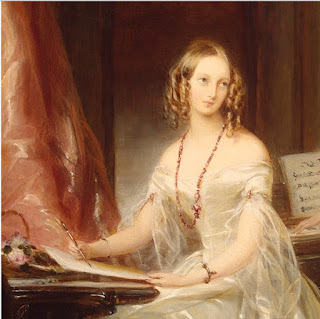
Grand Duchesses Alexandra Nikolaievna ('Adini')
and Alexandra Iosifovna ('Sanny')


Grand Duchess Alexandra Nikolaievna was the youngest daughter of Emperor Nicholas I of Russia. She died at the tender age of 19 in childbirth. 'Adini' had been suffering from tuberculosis even before her marriage to Prince Frederick William of Hesse-Kassel, but it was soon after her wedding that her health deteriorated rapidly. Her illness, her difficult pregnancy, and her tragic death was a dark episode to the otherwise happy and idyllic family life of the Russian emperor. 

Lively, talented, and mischievous, Adini was a favorite among her siblings, but she had a particular soft spot for her younger brother Konstantin who she called 'Kostya'. They bonded over shared love for music - she, a talented singer and he, a skillful player of musical instruments. Both were also artistically-inclined and voracious readers. ⁣When Adini died, Konstantin was on a sea voyage. He was then an officer of the Russian navy and when he received the news that his favorite sister died, he was profoundly affected. "...the sun's rays have faded forever in our family", he wrote in his journal. ⁣He often think about his sister, especially when he went on a campaign oversees, and he referred to her as his "guardian angel". 

3 years after the death of Adini, he fell in love with and married a German princess, Alexandra of Saxe-Altenburg. Curiously, his chosen bride not only bore the name of his dead sister, but she also looked a lot like her. 'Sanny' was a highly attractive and lively girl. Furthermore, she was also a music and an art lover. These qualities of Sanny greatly reminded him of Adini. When Sanny came to Russia and was introduced to Konstantin's mother for the first time, the Empress could not help but notice the physical resemblance and burst into tears. The sight of her future daughter-in-law undoubtedly brought back the happy and sad memories about Adini.


Grand Duke Konstantin Nikolaievich ('Kostya')
Portrait by Franz Kruger
(State Hermitage Museum, Russia)

Monday, June 1, 2020

Grand Duchess Maria Georgievna about the Grand Duchess Elizabeth Feodorovna

Grand Duchess Elizabeth Feodorovna
(Photo courtesy of https://www.worthpoint.com/)

"Grand Duchess Elizaveta Fedorovna came to [St.] Petersburg the very first winter I spent there. Her husband was the Governor-General of Moscow, and they did not often visit the capital. A few days after my arrival, the Grand Duchess called and led me to walk along the promenade. I have been especially fond of her since I first met her in Athens during my sister's engagement. She was especially kind and sweet with me, and since then we have become friends. Grand Duchess Elizabeth, Ella, was one of the most beautiful women of her time. Her head was in perfect shape, like a statue, and beautiful features. Her complexion was like rose petals, and she never used make-up or powder. At the ball, she was simply dazzling, always dressed beautifully and wore her wonderful jewelry like no other. I was devoted to her, and throughout all the years that I knew her, she was always the same kind and dear friend. The stay with her in the beautiful country house of her husband, Ilinskoe, near Moscow, was amazing. She did everything so that everyone felt at home, and could always do what she wanted. She kept herself simple, took part in all the fun and did everything in her power so that the guests had a good time."
~ From the memoirs of Grand Duchess Maria Georgievna 


Grand Duchess Maria Georgievna of Russia

Sunday, May 17, 2020

Queen Caroline of Bavaria: A Royal Stepmother and Mother

Stepmothers are often portrayed as wicked and evil in fairy tales and other stories. They were almost always the antagonist in a story and hell-bent in making the protagonist's life miserable. Among royal families, there were also stories of stepmoms who were (although not exactly wicked and evil), downright difficult or were unable to endear themselves to their stepchildren. Or stepchildren hating their stepmothers because they were loyal to the memory of their beloved biological mother. Then there were also stories of intrigues and family disputes.

But there was a royal stepmother who was the complete opposite of the fairy tales' portrayal. Not only was she became a beloved member of the family but also a doting and devoted stepmother to her stepchildren. She was Princess Caroline of Baden, future Queen of Bavaria.

Princess Caroline of Baden, was the second daughter of Charles Louis, Hereditary Prince of Baden and Princess Amalie of Hesse-Darmstadt. She came from a close-knit family, a characteristic that she would want for her own family someday. Her upbringing was more French than her native German, so it was quite ironic that several years later, she developed a deep hatred with anything French. This hatred was largely rooted to the execution of Louis Antoine Henri de Bourbon, Duke of Enghien, at the instigation of Napoleon Bonaparte. Caroline was said to be very much in love with the Duke and that her family considered him a potential husband for her. But they eventually had to drop the matter because of their fear of French opposition.

Caroline of Baden, later Queen of Bavaria, 1820.
Portrait from Karolinen Gymnasium

Sunday, May 10, 2020

Love and Marriage Prospects of the Grand Duchess Olga Nikolaevna

Grand Duchess Olga Nikolaievna of Russia
Detail from a portrait by Christina Robertson
(State Hermitage Museum, Russia)
Beautiful, elegant, imposing and intelligent – these were just some of the words used to describe the Grand Duchess Olga Nikolaievna, the second daughter of Emperor Nicholas I of Russia and his wife Alexandra Feodorovna.

As a young grand duchess in the Russian court, she was the focus of admiration among courtiers and members of the nobility. Contemporaries described her as tall and slender, graceful, blonde, with long eyelashes and a “divine” gleam in her eyes. There was kindness and gentleness in her expression, but she was also proud and judicious.

Despite her beauty, virtues, and her status as the daughter of the Russian emperor, Olga was not lucky in love, unlike her sisters. She married a future king and became a queen, just as her parents hoped, but the relationship with her husband was far from ideal.

Olga’s older sister, Grand Duchess Maria Nikolaievna, had married a prince of low rank, Maximilian of Leuchtenberg. Consequently, the Emperor and Empress hoped that their second daughter, would make a more brilliant match. They cherished the hope to someday see Olga marry a future king, however they did not want to force her to marry someone against her will.

Saturday, March 21, 2020

"A being in close contact with the ineffable and divine..."

Grand Duchess Elizabeth in her nun's habit
Photo courtesy of Klimblim

"Although she is approaching fifty, she has kept her slim figure and her old grace. Under her loose white woolen hood, she was as elegant and attractive as in the old days before her widowhood when she still inspired profane passions… Her face in the frame of her long white woolen veil was alive with spirituality. Her delicate features and white skin, the deep, far-away look in her eyes, the low, soft tone of her voice and the luminous glow round her brow all betrayed a being in close contact with the ineffable and divine."

- From the memoirs of Maurice Paleologue about the Grand Duchess Elizabeth as a nun.

Friday, March 20, 2020

Marie of Saxe-Altenburg, Queen of Hanover

Queen Marie of Hanover
Portrait by Joseph Stieler
In the middle of the 19th century, the German kingdom of Hanover was ruled by King Ernest Augustus, a British prince by birth, who was also the Duke of Cumberland. Long before Ernest Augustus became king, he had married the rather controversial and scandalous Frederica of Mecklenburg-Strelitz. Although their marriage can be said that it was out of love, their relationship with his family was quite sour. Frederica was disliked by most members of the British royal family and when Ernest Augustus became King of Hanover, he and Frederica wasted no time in setting up their court in Hanover. Frederica had only four years as queen and she died after an illness. She failed to endear herself with the people and as a result she did not become a popular queen.

Fortunately, her successor, the daughter-in-law she never met, was immensely popular with the people of Hanover.


Wednesday, March 18, 2020

Augusta of Saxe-Weimar-Eisenach, First German Empress

Augusta of Saxe-Weimar-Eisenach,
Queen of Prussia and Empress of Germany
Empress Augusta, consort of Emperor William I and the first empress of Germany, was born a Princess of Saxe-Weimar-Eisenach on September 30, 1811. She was the youngest daughter of Grand Duke Carl Frederick of Saxe-Weimar and Grand Duchess Maria Pavlovna of Russia, a granddaughter of Catherine the Great.

Princess Augusta spent her formative years in the literary court of Weimar. She received a well-rounded education that was carefully supervised by her mother. Maria Pavlovna was a highly-cultivated woman who presided over the cultural development of Weimar, while Augusta's father was a simple and timid man who nevertheless enjoyed the works of Goethe. Maria Pavlovna instilled in her daughter the strict observance of etiquette and courtly manners, and above all else, the importance of performing one's duties. Thus, while Augusta grew up in the romantic atmosphere of the Weimar court, where Goethe and other well-known writers and musicians throughout Germany frequented the grand ducal palaces, she also turned into an intelligent and well-read woman who possessed a firm and independent character.


Saturday, September 9, 2017

The Austrian Empress and the Russian Grand Duchess


"The Grand Duchess was always terribly interested in everything that concerned the Austrian Empress. Perhaps, some envy played a part in this, since the Empress was famous for her beauty. So, for example, the Grand Duchess often asked: "Is my hair as beautiful as the Empress? Do you not find that I am like her?" I remember how she once interrogated someone who has newly returned from Vienna, where he was traveling with an order to Emperor Franz Joseph, Adjutant-General von Stühler: "Who is more beautiful, the Austrian empress or I?" General Stühler, slightly embarrassed, replied: "If the Austrian empress is the most beautiful woman on Earth, your Highness is undoubtedly the most beautiful princess! "The Grand Duchess was satisfied with this answer."

--From the "Memories of a Shipwrecked World" by Countess Kleinmichel.

Monday, September 4, 2017

The idol of Moscow


"As for Grand Duchess Elizabeth Feodorovna, she was the idol of Moscow, the soul of every charitable enterprise and the ornament of every meeting. She was not shy, like her sister, Empress Alexandra Feodorovna, she knew how to talk to anyone about anything. She was everywhere, she knew everyone, and if her help was needed, she would render it with both hands. She had a rare gift of sympathy and understanding, which enabled her to enter into the position of each person."
-From the memoirs of Princess Lydia Leonidovna Vasilchikova, 1886-1919

Saturday, September 2, 2017

Marie of Baden, Duchess of Brunswick

I have always found the daughters of Charles Louis, Hereditary Prince of Baden quite interesting. In the past, I wrote several articles about his daughters, Caroline, Louise, and Frederica, and now I'll be continuing with Marie, second to the youngest daughter in the family.

Marie was born in 1782, the fifth daughter in a family of 7 children. Marie's family had a rather modest lifestyle as opposed to other noble houses of Europe, so her parents had to made up with this by ensuring that their children receive an excellent education which will strengthen their marriage prospects. Both Charles Louis and Amalie were politically astute individuals who tried to make the most out of their circumstances. As a result, Marie’s eldest sister, Caroline, would eventually become Queen of Bavaria, while her other sisters, Louise and Frederika would become, Empress of Russia and Queen of Sweden, respectively. Her younger sister Wilhelmine would become Grand Duchess of Hesse. Another sister, Amalie, who was the identical twin of Caroline, remained unmarried and would settle permanently in Russia with their sister Louise. Their brother Charles would marry Napoleon's step-niece, Stephanie de Beauharnais.

With her sisters and brother made brilliant marriages, it was also imperative for Marie to have the same brilliant marriage. She was suggested as a prospective bride to one of the sons of Charles William, Duke of Brunswick, Prince Frederick William

Like Marie, Frederick William also came from a large family. As the fourth son and since his eldest brother was already married, much cannot be expected of him inheriting his father's title. However, with his eldest brother proved to be incapable of having an issue and his two elder brothers declared invalid and excluded from the succession, Frederick William was now seen as the hope of the House of Brunswick in continuing the family line. His father began to put pressure on him to marry. On his part, Frederick William felt that there was no need for him to marry right away.

At the same time, Marie was not fond of the idea of marriage to Frederick William, since he already had a reputation of leading a rather “fast” life. However, Frederick William's family continued to put pressure on him to marry and he finally agreed to woo the young princess. Fortunately, he and Marie became fond of each other and they were married in Karslruhe on 1 November 1802. Their eldest child, Karl, was born two years later and they had another son, William, in 1806.

Marie's quiet family life in Brunswick was interrupted by the war against Napoleonic France. As her husband was a major-general in the Prussian army, he actively participated in the war zone. When Frederick William's father died from a wound he sustained in the battlefield, Marie and her mother-in-law, Augusta, went to his deathbed despite the danger. They were not allowed to remain for a long time and they were advised to flee. Marie's husband was captured and with two very young children with her, she had no choice but to flee in Northern Europe. She and her children accepted the offer of her brother-in-law, King Gustav IV Adolf of Sweden to take up residence with the royal family in Malmo. 

Marie with her eldest son, Karl
While in Sweden, Marie was constantly worried about the whereabouts of her husband and the future of their duchy. They were finally allowed to return to Germany in 1807 and she was reunited with her husband. Since Brunswick was now under Napoleon's control, they were not able to go back there and they stayed with Marie's family in Karlsruhe. While in Karlsruhe, Marie became pregnant with her third child, However, when she gave birth, the baby was stillborn, and Marie succumbed to puerperal fever. She died four days later, on December 8, 1808 at the age of 25.

Marie's life was short, but she led an exemplary life dedicated to, to her husband, and to the preservation of her duchy. After her death, Frederick William became a freedom-fighter and formed a corps raised from volunteers. They wore black uniforms which earned them the name "the Black Brunswickers". Frederick William, the Black Duke of Brunswick, became a local hero and a living legend. Perhaps as a way to give tribute to the memory of his wife, several streets, places and churches in Brunswick were named after. 

Tuesday, November 1, 2016

A Requiem for Adini


The Grand Duchess Alexandra Nikolaevna was the youngest daughter of Emperor Nicholas I of Russia and Empress Alexandra Feodorovna (born Princess Charlotte of Prussia). She was affectionately called "Adini" and her family loved her immensely. She was a favorite among her brothers and sisters because of her cheerful, spirited and mischievous nature. Her death at the age of 19 devastated the whole family and this left a lasting sorrow to the otherwise blissful family life of Nicholas I. This event also left a profound effect on each family member, particularly on Grand Duchess Olga, who was very close to her sister. On her memoirs, Olga wrote about her relationship with her sister, the courtship between Adini and Frederick William of Hesse-Kassel, Adini's marriage, sickness and subsequent death.

The following was an excerpt from the memoirs of the Grand Duchess Olga entitled "The Golden Dream of My Youth".


Sunday, September 18, 2016

"A charming effect that is impossible to describe"


"Those who were given the good fortune to see up close the Empress Elizabeth had the opportunity to judge the extreme sociability of her nature and her extraordinary judgment. Gifted with great tact and exquisite taste, having a mass of diverse and deep knowledge, she always tried to hide her talents, as opposed to that zeal and skill with which she showed to ordinary people. Her nature had the property of contemplation which allowed her to see the serious side of her surrounding; but at the same time her passion and imagination gave her a charm and grace of simplicity; combining all these qualities engendered a charming effect that is impossible to describe."

- From an essay about the spouse of Alexander I "Empress Elizabeth Alexeievna" by Sergei Semenovich Uvarov. Published in the journal "Russian Antiquity" in 1884.

Wednesday, September 7, 2016

Tatiana Vasilievna Engelhardt, Princess Yusupova

Princess Tatiana Yusupova
by Elisabeth Louise Vigee Lebrun
Today my post is dedicated to the great-grandmother of the famous Russian belle and heiress, Princess Zinaida Yusupova
Zinaida's great-grandmother was Princess Tatiana. She was actually born as Tatiana Engelhardt into a family of an impoverished gentry in Smolenk, Russia named Vasily Engelhardt. Her mother was Martha Elena Alexandrovna Potemkin, sister of Grigory Potemkin, who would go down in history as a brilliant military leader, statesman and a lover of Catherine the Great. Tatiana's childhood coincided with that period when her uncle rose to power. As a result, she and her sisters made a brilliant match because of their uncle's influence at the Russian court. Possessing both beauty and a gentle nature, and not to mention her uncle's protection, she was destined to have a bright future.
Tatiana and her five sisters were orphaned at a very young age. They were left to the care of their grandmother and as a result, they received little education and their manners were unpolished. As their uncle Potemkin rose to power, he took the sisters under his protection and brought them to the Russian court, where the Empress Catherine treated them generously. They were treated almost as grand duchesses and soon they learned how to be sophisticated and act accordingly.

Tatiana, at the age of 12, was appointed as a maid-of-honor to the Empress Catherine. And although she came from a poor province, she attracted admiration and attention at the court not only for being the niece of Potemkin but also for being a witty and lively girl. When the Duchess of Kingston visited St. Petersburg and was invited at court, she became strongly attached to the then 15 year-old Tatiana, treating her like her own daughter. The Duchess even told Tatiana that she would make her the heiress of her vast fortune if she would agree to live with her in England. Tatiana, however, refused.
Instead, her uncle arranged her to be married to her uncle and mother's cousin who was 25 years her senior, Mikhail Potemkin. Her uncle gave her a large dowry which further made her an attractive bride. The couple had two daughters, with the Empress serving as their godmother. However, the marriage did not last long - Tatiana's husband died six years later. It was a blow for her and she retired from court life, occasionally appearing only at the request of the Empress herself. 
But soon enough, she met a dashing nobleman named Prince Nikolai Borisovich Yusupov, who had just returned to Russia from Italy where he was working at the embassy. He and Tatiana married in 1793 with Catherine's blessing and a year later, they had a son, Boris. Despite the promising start of their married life, Nikolai and Tatiana's marriage would be a failure and soon enough the couple started living separately. Nikolai stayed in Arkhangelskoye Grand Palace while Tatiana moved to Caprice Palace where she managed the Kupavinskaya textile plant, one of Prince Nikolai’s properties. Along with the management of her husband's estate, she also devoted her time in raising her son Boris.

Despite her wish for a more quiet and secluded life, this would prove to be almost impossible. Her intellectual pursuits and artistic inclinations attracted a group of likewise intellectual and artistic people who frequented her home including the Russian poet Gavrila Derzhavin who dedicated a poem for her entitled "To a mother who brings up her children herself", Vasily Zhukovsky and Alexander Pushkin.

Tatiana also proved to be skillful and highly competent in the management of their estates. Under her supervision, she was able to increase the already vast fortune of the Yusupovs (which is also due to her inheritance from Potemkin that amounted to 18 million rubles) and her practical ability and financial acumen made her acquired substantial properties. But people were surprised by her modest lifestyle and her disdain for flamboyance and ostentatious display of wealth and they sometimes mistook it for stinginess. However, she was spending large sums of money for charity which she donated anonymously.

Tatiana, with an eye for beauty, was fascinated with jewelry and she possessed some of the most dazzling jewelry collections. Among them was the world-famous Polar Star Diamond, the diamond earrings of Marie Antoinette, a sapphire statue of Venus, the pearl and diamond tiara of Caroline Murat and the Peregrina pearl.

Tatiana died in May 25, 1841 and the large fortune of the Yusupovs was inherited by her only son, Boris.

Friday, August 12, 2016

Grand Duchess Olga Nikolaievna in England

The Grand Duchess Olga Nikolaievna of Russia and her husband, Charles, Crown Prince of Wurttemberg visited England in August 5, 1853. They were warmly received by Queen Victoria at Osborne House a few days after their arrival. The young Queen wrote to his uncle Leopold, King of the Belgians about Olga:
"Olga is still very handsome as to features, figure, but she is a wraith which is a sad thing for one who was so beautiful and is so young. She is terribly thin and pale... Her manners are very dignified and pleasing."


(Photo courtesy of The Hermitage Museum, St. Petersburg
Quote courtesy of The Royal Collection)


Saturday, August 6, 2016

Elisabeth Ludovika of Bavaria, Queen of Prussia

Princess Elisabeth Ludovika of Bavaria,
Queen Consort of Prussia
by Joseph Stieler
My post for today is about another beloved Prussian queen, Elisabeth Ludovika, consort of Frederick William IV of Prussia. The Bavarian-born princess was one of the daughters of Maximilian I, King of Bavaria and his second wife, Caroline of Baden. Elisabeth, called "Elise" by her family, has an identical sister named Amalie who would become Queen of Saxony. By all accounts, Elisabeth's childhood was happy and carefree. She and her sisters were allowed to roam freely around the Nymphenburg Palace. Court atmosphere was tolerant and liberal, owing to their father's preference for a simple and bourgeois way of life. The Bavarian princesses were also taught in literature, history and geography by the philologist and theologian Friedrich Thierch. The Bavarian royal family spent their summers in Tegernsee, where the countryside greatly appealed to Elisabeth. Her visits to Tegernsee intensified her love for her homeland and she would always remain a Bavarian in heart and soul.

Saturday, June 4, 2016

Elisa Radziwill and Prince William of Prussia: A Love Found and Lost

Princess Elisa Radziwill as the Goddess Peri by
Wilhelm Hensel. She wore this costume on the
play "Lalla Rookh".
(Courtesy of Getty Images)
Long before Kaiser William I, became King of Prussia and German Emperor, he had been in love with a pretty Polish princess named Elisa Radziwill. Theirs was a touching but poignant story; due to their ranks and the political circumstances surrounding them, the call of duty eventually outweighed their love for each other. Love was not enough to conquer all. 

Friday, June 3, 2016

From Royal to Monastic: Grand Duchess Alexandra Petrovna of Russia

Alexandra of Oldenburg,
Grand Duchess Alexandra Petrovna of Russia
Another member of the Romanov family that I am writing about today is the Grand Duchess Alexandra Petrovna, wife of Grand Duke Nicholas Nikolaievitch, third son of Tsar Nicholas I of Russia. The Grand Duchess Alexandra was a scion of the German princely family of Oldenburg, who were descended from Tsar Paul I thru his daughter, Grand Duchess Catherine Pavlovna. The Grand Duchess Catherine married Duke George of Oldenburg and they had two sons. The youngest one, Peter, was Alexandra's father.

Prince Peter, despite his Oldenburg title, was born and raised in Russia. He married Princess Therese of Nassau-Weilburg in 1837 and together they had eight children; Alexandra was their eldest child.

Sunday, April 17, 2016

Adelheid-Marie of Anhalt-Dessau, Grand Duchess of Luxembourg

Adelheid-Marie of Anhalt-Dessau,
Grand Duchess of Luxembourg
The first Grand Duchess of Luxembourg was Adelheid-Marie of Anhalt-Dessau. She was the second wife of Luxembourg's first Grand Duke, Adolf of Nassau. Adelheid-Marie was born on Christmas Day 1833 in Dessau, a small duchy in Central Germany, the eldest daughter of Friedrich-August Prince of Anhalt-Dessau and Landgravine Marie-Luise of Hesse-Kassel.

Adelheid-Marie had two younger sisters, Bathildis and Hilda. The children grew up in the Stadtschloss Dessau in Dessau and in the Rumpenheim Castle in Offenbach. It was in Rumpenheim that the 16-year-old Adelheid-Marie met for the first time the Duke Adolf of Nassau. Adolf was 34 years old and he was a widower since 1845. His first wife was the Grand Duchess Elizabeth Mikhailovna of Russia but the young grand duchess, who was suffering from tuberculosis, had died in childbirth, less than a year after their marriage. The baby had died as well. Adolf was deeply affected by this tragedy that he remained a widower for almost 5 years but he had to remarry to give his duchy an heir.

Adolf and Adelheid-Marie were married two years after their first meeting, in Dessau, on April 21, 1851. They spent their honeymoon in Oranienstein Castle, and Adelheid-Marie was so enchanted by the beautiful and elegant castle that it was chosen to be their summer residence. The couple set-up their court in Wiesbaden and their official residence was the Biebrich Palace, picturesquely located in the banks of the Rhine River. They had five children:Wilhelm, the future Grand Duke William IV, Friedrich, Mary, Franz, and Hilda, future Grand Duchess of Baden.

During the Austro-Prussian War of 1866, Adolf sided with Austria and it proved to be a bad decision. Austria was defeated and Prussia henceforth annexed the Duchy of Nassau. Adolf and Adelheid-Marie lost their throne and lived in exile in Vienna and then Frankfurt. In 1870, Adolf bought Schloss Hohenburg in Bavaria and this became the family's new residence; in here, Adolf was able to pursue his passion for hunting while Adelheid-Marie, her love for painting. She painted numerous watercolors of landscapes and nature, and she even participated in the decoration of an Evangelical church built on a donated land; she painted the flowers on the church's pulpit and donated chandeliers for the church.


In 1879, Adolf succeeded in the Grand Duchy of Luxembourg, and Adelheid-Marie became the first Grand Duchess of Luxembourg. After the death of Adolf in 1905, Adelheid-Marie, now the Dowager Grand Duchess, stayed most of her time in Königstein. Her son, now the Grand Duke William IV died in 1912, after being ill for many years, and he was succeeded by his eldest daughter, Marie-Anne. The six princesses of Luxembourg relied heavily on their grandmother, Adelheid-Marie, for support and advice. She was responsible for their education and gave them drawing lessons. She also received numerous visits from her daughter Hilda, Grand Duchess of Baden, who had apartments in Königstein; eventually, Königstein will pass to Hilda after her mother's death. Even in her old age, the plight of the needy was still in her mind and she did not hesitate in giving patronage to various charities. In 1905, her paintings were exhibited, and the proceeds from the exhibit will be given for the benefit of the poor.

The Dowager Grand Duchess Adelheid-Marie  died at the age of eighty-three years in Königstein on November 24, 1916. A funeral service was held in the village church in the middle of World War II, and among the present was the son of Emperor Wilhelm II. The people of Königstein sincerely mourned Adelheid-Marie's death and her memory is still alive today. After the funeral, her body was buried alongside her husband in the crypt of the Weilburg castle.


Monday, April 13, 2015

"Same beautiful soul"

Portrait of the Grand Duchess Ella 
by Friedrich August von Kaulbach.
Colorized by me. :-)

German portraitist Friedrich August von Kaulbach painted several portraits of the Grand Duchess Elizabeth throughout the late 19th century when she was apparently at the height of her beauty. Her brother Ernst-Ludwig particularly likes Ella's portraits by Kaulbach for they capture some of that elusive charm that most artists failed to convey on her other portraits. In this portrait, Ella's elegant, supple and graceful figure were apparent, as well as her beautiful Greek profile and that faraway look in her eyes. At the same time, she projects an aura of exquisite delicacy, simplicity and nobility. The Grand Duke Konstantin Konstantinovich, who was in awe of the newly-married Ella, describe her in his diary: "She is so feminine; I am struck by her beauty. Her eyes wonderfully delineate calm and gentleness. In her, despite her gentleness and shyness, there is a certain feeling of self-confidence, a sense of power. Under such a beautiful appearance must be the same beautiful soul." 


Monday, April 6, 2015

The Daughters of Prince Ivan Baryatinsky

Prince Ivan Baryatinsky was one of the most influential nobles in Russia of the early 19th century. He was a wealthy landowner and the owner of several palaces throughout Russia and Europe. As the sole heir of his father, Prince Ivan inherited the vast fortune of his family. He first served in the Yekaterinoslav Hussars of the Russian Imperial Army as a young man, and he later distinguished himself as an astute diplomat and was made Russian ambassador first in London and then at the court of the King of Bavaria in Munich. While he was on a diplomatic service in London, he met and married an Englishwoman named Frances Mary Dutton, the daughter of Lord Sherborne. They had one daughter, Elizabeth, but Frances Mary died in 1807. Later that year, Prince Ivan was sent to Bavaria as the Russian ambassador and there he met and married a German countess, Maria Keller, with whom he had four sons and three daughters. It was a match made in heaven. Prince Ivan and the now Maria Feodorovna were a good-looking and generous couple, and enjoyed a successful marriage. Prince Ivan was especially interested in agronomics and applied the things he learned from his travels all over Europe in the development and management of his estates. Princess Maria Feodorovna, on the other hand, was a philanthropist. She was particularly involved in charity and other social causes. After their marriage, Prince Ivan built a magnificent palace complex in Kursk which he named "Marino" in honor of his first and second wives. In here, his children grew up and received an excellent education with special emphasis on Christian values. Thus, the Baryatinsky children will grow up to closely follow their parents' examples in philanthropy and social astuteness.


Princess Olga Ivanovna Baryatinsky,
Countess Orlova-Davydova 
Olga, born in 1814, was the eldest daughter of Prince Ivan and Maria Feodorovna Keller. She married Count Vladimir Petrovich Orlov-Davydov in 1832. Count Davydov was a scion of one of the most powerful noble families in Russia. He was a wealthy landowner and a philanthropist. He was educated in Britain and as a result, he acquired a great love for Britain and its culture. Olga and Davydov primarily lived in Orel and there Olga took interest in the welfare of the people. She was described to have possessed a wonderful character. Her simplicity and unassuming ways particularly in the way she treats peasants amazed courtiers and dignitaries. Like her mother, Olga had a developed social conscience. She and Davydov made it a point that charity must be a foremost importance in their life. They built schools, churches, hospitals and charitable institutions. The writer Aksarov who had the opportunity to see the couple's charitable work was surprised with their attitude towards ordinary people. He wrote that they "lead a living union with the Church, and not less than a living union with the Russian people", and that the "Russian village became a part of Olga's moral being". She was well-acquainted with peasant life and with the needs of the people both in general and in detailed. After her mother's death, Olga inherited the guardianship of the Community of the Sisters of Charity, which her mother founded. 


Princess Leonilla Ivanovna Baryatinsky, 
Princess of Sayn-Wittgenstein-Sayn
Born in 1816, Leonilla was the second daughter. The princess, like her brothers and sisters, was highly educated and cultured. When she was 16 years old, her mother brought her to St. Petersburg to be introduced to the Empress Alexandra Feodorovna. She immediately became famous at the court for her attractive looks. She was described to be tall like a 'Lebanese cedar, slender, somewhat restrained and very serious, but beautiful from head to toe'. Her 'velvet eyes and sable eyebrows' gave her an 'Italian look'. In the spring of 1834, she became a maid-of-honor to the Empress. However, less than year after her appointment, the beautiful and cultured Leonilla married the Tsar's aide-de-camp, Prince Ludwig of Sayn-Wittgenstein-Berleburg, who was also a widower. After their marriage, Leonilla and her husband left Russia and settled in their estate in Vilna, Lithuania. Prince Wittgenstein inherited a vast fortune from his first wife, which afforded him and Leonilla to lead a luxurious lifestyle. Following her mother's example, Leonilla was also interested in charity and founded several schools and hospitals for the poor. Although their marriage started happily, Leonilla and her husband soon drifted away from each other. She converted to Catholicism and fell into a sort of religious mania. She had an affair with a Frenchman while her husband settled in the wing of the castle with his German mistress. Before the the Prince's death in 1866, he and Leonilla were somewhat reconciled. "Thus ended", wrote the writer Smirnov, "this married life that started with feigned love, passed on for a short time in indifference, and then in friendship..." As a widower, she became a close friend of the Empress Augusta of Germany and tried to help her resolve a number of diplomatic issues to prevent the Franco-Prussian War. In the last 30 years of her life, Princess Leonilla lived in a villa at Ouchy, overlooking Lake Geneva. For many years, her homes has been a "bourne of crowned heads and imperial personages". One of her oldest friends is the Dowager Grand Duchess of Mecklenburg-Strelitz, 94, who, until the outbreak of the war, would visit once a year. Until the last days of her long life, Leonilla, kept an excellent memory and a sober mind. She died in 1918 at the age of 102.


Princess Maria Ivanovna Baryatisnky,
Princess Kochubey
The youngest daughter of the family, Maria, was born in 1818 . Like her mother and her sisters, she was also a famous beauty at the Russian court. She also became a maid-of-honor to the Empress Alexandra and a close friend of the Empress's daughter, Grand Duchess Olga Nikolaievna. The Grand Duchess fondly remembers Maria in her memoirs:
"After the start of the Lent was the end of all celebrations. Only a few were invited to gather in the evening with Mama in the Green Room, where for the most part we read aloud. Among these guests were Princess Baryatinsky and her daughter Maria. Her shyness and modesty endeared her to me and soon we became friends. She was serious and deeply religious. The friendship between us was truly what I've always dreamed of: she ennobled our nature. We both were full of ideals according to our age... We are especially protective of our desires, thoughts and ideas from prying eyes. Maria Baryatinsky was blond with black eyebrows, her eyes if she sympathized with anyone, were full of warmth, which I have not seen in anybody, except for the Empress Maria Alexandrovna (wife of Emperor Alexander II), perhaps because I truly loved them both.
Maria Baryatinsky's hair was the same as mine. When she unravels her hair, it covered her knees. She plaits it into a twine three times around the head and fastened it with gold pin. I remember one birthday celebration of Papa in Peterhof. Despite the fact that Baryatinsky lived nine miles from there, she came with fresh flowers on her hair. Most of the flowers were still in bud, and during a dance, they were dispersed. The portrait by the famous artist Robertson captured her in all her charms while she was about to play the piano. In 1841, she married Mikhail Kochubey, and eighteen months later she is gone. She died of a fever... How short this friendship was! But this remains an indelible trace in my soul. Her sister Leonilla, the future Princess Wittgenstein. was also very attractive, but her beauty was of the earth, while Maria was like an angel. In Maria, I found an echo of myself, and this four-year friendship was just beautiful. "
After Maria's early death, her mother founded a shelter for poor women as a dedication to her.


Portraits of Prince Ivan Baryatinsky and Princess Maria Feodorovna nee Keller

Related Posts Plugin for WordPress, Blogger...
 
Powered by Blogger