Showing posts with label Romanovs. Show all posts

Wednesday, June 3, 2020

"Adini and Sanny"


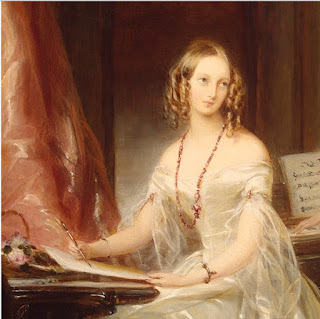
Grand Duchesses Alexandra Nikolaievna ('Adini')
and Alexandra Iosifovna ('Sanny')


Grand Duchess Alexandra Nikolaievna was the youngest daughter of Emperor Nicholas I of Russia. She died at the tender age of 19 in childbirth. 'Adini' had been suffering from tuberculosis even before her marriage to Prince Frederick William of Hesse-Kassel, but it was soon after her wedding that her health deteriorated rapidly. Her illness, her difficult pregnancy, and her tragic death was a dark episode to the otherwise happy and idyllic family life of the Russian emperor. 

Lively, talented, and mischievous, Adini was a favorite among her siblings, but she had a particular soft spot for her younger brother Konstantin who she called 'Kostya'. They bonded over shared love for music - she, a talented singer and he, a skillful player of musical instruments. Both were also artistically-inclined and voracious readers. ⁣When Adini died, Konstantin was on a sea voyage. He was then an officer of the Russian navy and when he received the news that his favorite sister died, he was profoundly affected. "...the sun's rays have faded forever in our family", he wrote in his journal. ⁣He often think about his sister, especially when he went on a campaign oversees, and he referred to her as his "guardian angel". 

3 years after the death of Adini, he fell in love with and married a German princess, Alexandra of Saxe-Altenburg. Curiously, his chosen bride not only bore the name of his dead sister, but she also looked a lot like her. 'Sanny' was a highly attractive and lively girl. Furthermore, she was also a music and an art lover. These qualities of Sanny greatly reminded him of Adini. When Sanny came to Russia and was introduced to Konstantin's mother for the first time, the Empress could not help but notice the physical resemblance and burst into tears. The sight of her future daughter-in-law undoubtedly brought back the happy and sad memories about Adini.


Grand Duke Konstantin Nikolaievich ('Kostya')
Portrait by Franz Kruger
(State Hermitage Museum, Russia)

Monday, June 1, 2020

Grand Duchess Maria Georgievna about the Grand Duchess Elizabeth Feodorovna

Grand Duchess Elizabeth Feodorovna
(Photo courtesy of https://www.worthpoint.com/)

"Grand Duchess Elizaveta Fedorovna came to [St.] Petersburg the very first winter I spent there. Her husband was the Governor-General of Moscow, and they did not often visit the capital. A few days after my arrival, the Grand Duchess called and led me to walk along the promenade. I have been especially fond of her since I first met her in Athens during my sister's engagement. She was especially kind and sweet with me, and since then we have become friends. Grand Duchess Elizabeth, Ella, was one of the most beautiful women of her time. Her head was in perfect shape, like a statue, and beautiful features. Her complexion was like rose petals, and she never used make-up or powder. At the ball, she was simply dazzling, always dressed beautifully and wore her wonderful jewelry like no other. I was devoted to her, and throughout all the years that I knew her, she was always the same kind and dear friend. The stay with her in the beautiful country house of her husband, Ilinskoe, near Moscow, was amazing. She did everything so that everyone felt at home, and could always do what she wanted. She kept herself simple, took part in all the fun and did everything in her power so that the guests had a good time."
~ From the memoirs of Grand Duchess Maria Georgievna 


Grand Duchess Maria Georgievna of Russia

Sunday, May 10, 2020

Love and Marriage Prospects of the Grand Duchess Olga Nikolaevna

Grand Duchess Olga Nikolaievna of Russia
Detail from a portrait by Christina Robertson
(State Hermitage Museum, Russia)
Beautiful, elegant, imposing and intelligent – these were just some of the words used to describe the Grand Duchess Olga Nikolaievna, the second daughter of Emperor Nicholas I of Russia and his wife Alexandra Feodorovna.

As a young grand duchess in the Russian court, she was the focus of admiration among courtiers and members of the nobility. Contemporaries described her as tall and slender, graceful, blonde, with long eyelashes and a “divine” gleam in her eyes. There was kindness and gentleness in her expression, but she was also proud and judicious.

Despite her beauty, virtues, and her status as the daughter of the Russian emperor, Olga was not lucky in love, unlike her sisters. She married a future king and became a queen, just as her parents hoped, but the relationship with her husband was far from ideal.

Olga’s older sister, Grand Duchess Maria Nikolaievna, had married a prince of low rank, Maximilian of Leuchtenberg. Consequently, the Emperor and Empress hoped that their second daughter, would make a more brilliant match. They cherished the hope to someday see Olga marry a future king, however they did not want to force her to marry someone against her will.

Saturday, March 21, 2020

"A being in close contact with the ineffable and divine..."

Grand Duchess Elizabeth in her nun's habit
Photo courtesy of Klimblim

"Although she is approaching fifty, she has kept her slim figure and her old grace. Under her loose white woolen hood, she was as elegant and attractive as in the old days before her widowhood when she still inspired profane passions… Her face in the frame of her long white woolen veil was alive with spirituality. Her delicate features and white skin, the deep, far-away look in her eyes, the low, soft tone of her voice and the luminous glow round her brow all betrayed a being in close contact with the ineffable and divine."

- From the memoirs of Maurice Paleologue about the Grand Duchess Elizabeth as a nun.

Saturday, January 4, 2020

A Mother's Advice to Her Daughter

Portrait of Princess Charlotte of Prussia as a Grand Duchess of Russia.

 Below is an excerpt from a letter of Queen Louise of Prussia to her eldest daughter, Princess Charlotte. Queen Louise never saw her daughter eventually become Empress of Russia as consort of Nicholas I as the Queen died when Charlotte was only 12 years old.

"Dear Charlotte, listen to these cheerful cries and the bells ringing with reverence... Those who want to deserve this, must respond with love to the love of their people; must have a heart capable of sharing their sufferings and joys; and the most important thing - one must be with the people... Remember this, my daughter, and if you ever get to wear a crown, remember this solemn hour."


Queen Louise of Prussia

-------------------------------------------------------------------------------------
From a letter of Queen Louise to her daughter - Princess Charlotte, future Empress Alexandra Feodorovna, wife of Nicholas I of Russia

Thursday, January 24, 2019

January 24, 1779 - Birth of the Empress Elizabeth Alexeievna


"Today, on your birthday, my dear Eliza, I write this letter in response to yours, passed by Amelia [Elizabeth's sister]. May Heaven grant you happiness and bliss in this world! This is my most heartfelt and ardent desire! But for this, you should adhere to the principle that you have defined for yourself in the form of a motto: patience and perseverance! Remind yourself that it was Providence that determined your place; leaving it voluntarily would be a sign for the disgruntled."

-Extract from a letter written by the Margravine of Baden to her daughter the Empress Elizabeth on the latter's birthday on January 24, 1811.

Sunday, November 18, 2018

New Portrait of the Grand Duchess Elizabeth Feodorovna


A lovely portrait of the Grand Duchess Elizabeth Feodorovna by little-known Russian artist, Ekaterina Ieronimovna Viskovatova, 1896. 
This particular painting of the Grand Duchess is currently on display at the Buckingham Palace as part of the exhibit, "Russia, Royalty and the Romanovs"
Courtesy: The Royal Collection

Wednesday, July 18, 2018

In Remembrance of the Martyrdom of the Grand Duchess Elizabeth

Grand Duchess Elizabeth from a black-and-white photo,
colorized by Klimbim

Today marks the 100th anniversary of the martyrdom of the Grand Duchess Elizabeth Feodorovna of Russia. She, along with other members of the extended Imperial Family, were murdered by Bolsheviks on July 18, 1918, in the Siberian town of Alapayevsk. Their death, even with those of the Tsar and his family, a day before, were one of the bloodiest chapters on the history of Russia. 

As a commemoration to this beautiful and selfless woman, who has been an inspiration to me for so many years already, here are quotes from her cousin and admirer, Queen Marie of Romania:

"Aunt Ella, on these occasions was so fairy-like an apparition that I would like to dip my pen in colour, so as to be able to make her live again, if only for a moment, because eyes that have never beheld her will never be able to conceive what she was. With that divine smile curving her perfect lips, with a blush on her cheeks, only comparable to almond-blossoms, and an almost bashful look in her long-shaped, sky-blue eyes... Her gown, heavily embroidered in silver, is a colour which is neither blue nor green, the colour of glaciers or of aquamarine; her kokoshnik of emeralds and diamonds is truly a halo for her angelic face, and the gorgeous jewels, covering arms and throat, have, when she wears them, the aspect of gifts, piously offered to some beloved saint."
----------------------------------
"Aunt Ella, beautiful, beautiful Aunt Ella, may something of my love for you reach you in that faraway country where you rest in a martyr's grave. Now you are in the Holy Land, the victim of this world, too dark for your light."

Monday, September 4, 2017

The idol of Moscow


"As for Grand Duchess Elizabeth Feodorovna, she was the idol of Moscow, the soul of every charitable enterprise and the ornament of every meeting. She was not shy, like her sister, Empress Alexandra Feodorovna, she knew how to talk to anyone about anything. She was everywhere, she knew everyone, and if her help was needed, she would render it with both hands. She had a rare gift of sympathy and understanding, which enabled her to enter into the position of each person."
-From the memoirs of Princess Lydia Leonidovna Vasilchikova, 1886-1919

Tuesday, November 1, 2016

A Requiem for Adini


The Grand Duchess Alexandra Nikolaevna was the youngest daughter of Emperor Nicholas I of Russia and Empress Alexandra Feodorovna (born Princess Charlotte of Prussia). She was affectionately called "Adini" and her family loved her immensely. She was a favorite among her brothers and sisters because of her cheerful, spirited and mischievous nature. Her death at the age of 19 devastated the whole family and this left a lasting sorrow to the otherwise blissful family life of Nicholas I. This event also left a profound effect on each family member, particularly on Grand Duchess Olga, who was very close to her sister. On her memoirs, Olga wrote about her relationship with her sister, the courtship between Adini and Frederick William of Hesse-Kassel, Adini's marriage, sickness and subsequent death.

The following was an excerpt from the memoirs of the Grand Duchess Olga entitled "The Golden Dream of My Youth".


Sunday, September 18, 2016

"A charming effect that is impossible to describe"


"Those who were given the good fortune to see up close the Empress Elizabeth had the opportunity to judge the extreme sociability of her nature and her extraordinary judgment. Gifted with great tact and exquisite taste, having a mass of diverse and deep knowledge, she always tried to hide her talents, as opposed to that zeal and skill with which she showed to ordinary people. Her nature had the property of contemplation which allowed her to see the serious side of her surrounding; but at the same time her passion and imagination gave her a charm and grace of simplicity; combining all these qualities engendered a charming effect that is impossible to describe."

- From an essay about the spouse of Alexander I "Empress Elizabeth Alexeievna" by Sergei Semenovich Uvarov. Published in the journal "Russian Antiquity" in 1884.

Friday, June 3, 2016

From Royal to Monastic: Grand Duchess Alexandra Petrovna of Russia

Alexandra of Oldenburg,
Grand Duchess Alexandra Petrovna of Russia
Another member of the Romanov family that I am writing about today is the Grand Duchess Alexandra Petrovna, wife of Grand Duke Nicholas Nikolaievitch, third son of Tsar Nicholas I of Russia. The Grand Duchess Alexandra was a scion of the German princely family of Oldenburg, who were descended from Tsar Paul I thru his daughter, Grand Duchess Catherine Pavlovna. The Grand Duchess Catherine married Duke George of Oldenburg and they had two sons. The youngest one, Peter, was Alexandra's father.

Prince Peter, despite his Oldenburg title, was born and raised in Russia. He married Princess Therese of Nassau-Weilburg in 1837 and together they had eight children; Alexandra was their eldest child.

Monday, March 16, 2015

Royal Portrait: The Grand Duchess Elizabeth Feodorovna

(Portrait from the Royal Collection)
The newly-married Grand Duchess Elizabeth Feodorovna wrote to her grandmother, Queen Victoria on June 13, 1884, about her portrait by Russian painter Alexander Sokolov.

"He began to do my portrait, and I think he will be very successful. Sergei and I hope that you will enjoy it, and we'll send it to you as a present for Christmas and birthday. You may be interested to know what I wear - a dress of pale pink gauze, a lot of lace, a little open - so you can see the neck and the sleeves are not very long. I hold an open umbrella on one hand and on the other - a large white straw hat with flowers, tied with a pink ribbon. It looks as if I was walking in the garden... " 


Sunday, March 15, 2015

First Anniversary of the Death of Grand Duchess Alexandra Nikolaievna

Grand Duchesses Olga and Alexandra Nikolaievna by Christina Robertson (Hermitage Museum)
In the excerpt below, Grand Duchess Olga Nikolaievna, Queen of Wurttemberg, remembers the first death anniversary of her beloved sister, Alexandra. The 19-year-old Grand Duchess Alexandra, who was suffering from consumption, died after prematurely giving birth to her son. The baby died as well soon afterwards, and this tragedy profoundly affected the imperial family.
"By the day of the death of Adini, Fritz of Hesse came. We went with him to Tsarskoye Selo, where in a small chapel at the pond was placed a statue of Adini. In the pavilion, which was built for her, waiting to be fed, are black swans. But at the top of the palace there was no longer a balcony in front of her bathroom and the lilac under her windows with their flowering branches reach the window. In the palace chapel a requiem was held. All these memories of last year came bursting in my heart: she was lying with her baby in a sea of colors and it seemed to me that with my beloved sister, I also buried my youth. Then we went to the Fortress [of Peter and Paul] and on that same night we went back to Yelagin [Palace]. When I think about my last summer in my homeland, I am seized with an inexpressible longing for all those who have gone before me to another life.

Friday, February 20, 2015

"Poor Aunt Julia"

Portrait of the Grand Duchess Anna Feodorovna of Russia,
from the Royal Collection.


The Grand Duchess Anna was born as Princess Juliane of Saxe-Coburg-Saalfeld. She was an aunt of Queen Victoria. She married Grand Duke Constantine Pavlovich of Russia, second son of Tsar Paul I, when she was only 15 years old. The marriage was unhappy and ended in divorce. Anna later settled in Switzerland and died there in 1860.

In 1841, her niece, Princess Feodora went to Geneva, and later reported to her half-sister, Queen Victoria about her meeting with their Aunt Julia: "I went to see Mama and Aunt Julia, who I find very much changed, she looks now an old woman, such a pity, for she was so lovely once. ...Her life full of trials of all kind, her youth thrown away at that court, and now alone, amongst strangers here is indeed a bitter cup to the last... poor aunt, life must be a burthen to her; and her feelings are so young still." 

(Quotes from the Royal Collection.)

Sunday, January 18, 2015

Royal Portrait: Portrait of Queen Anna of the Netherlands


Portrait of Queen Anna of the Netherlands,
born Grand Duchess Anna Pavlovna of Russia by Timoteo Neff.
From the collection of the Museum of Fine Arts of Yeketerinburg
(Image from ei.ru)

The Grand Duchess Anna was certainly a force to be reckoned with. She was a lover of pomp and ceremony, never forgetting for a moment that she was a Russian grand duchess before she became queen. In this portrait, a middle-aged Anna was a wearing a Russian court dress adorned with rubies and diamonds and a kokoshnik embellished with pearls, rubies and diamonds.

Tuesday, December 9, 2014

The Romance of an Empress


The Romanov Family was infamous for its story of drama and tragedy. It was this aspect that probably fascinates people the most. Each member of the family, whether they were born into it or married into it, seems to have his or her own unique story to tell. And so for today, I'd like to explore one of the least known member, Empress Elizabeth Alexeievna, wife of Alexander I.

Emperor Alexander I's life was a mystery and continues to be so. His upbringing, his role in his father's death, his domestic and foreign policies, his personality, and the circumstances of his death are all shrouded in enigma. His wife Elizabeth and her life also has its own fair share of drama, tragedy, romance, and mystery. When I was reading about Elizabeth's life, it was like watching a soap-opera and a legend rolled into one. I could not help but be fascinated with this lady, although largely unknown to most history buff, was still quite a personality. She was adored by poets and musicians, and contemporaries and later historians and authors are drawn to her; and it's quite understandable why. Elizabeth was an attractive woman. Her beauty was often described as the angelic kind and this gave her an almost unearthly and ethereal appearance. She was both beautiful and intelligent but sad and inaccessible. She was the perfect muse for an uninspired artist, the perfect heroine of a doomed love story, and the perfect angel to a lost man.


Friday, October 3, 2014

The Grand Duchess and Her Palace


The Grand Duchess Maria Nikolaievna, eldest daughter of Emperor Nicholas I of Russia, was a gifted artist. Her artistic and aesthetic inclinations led her to do numerous paintings in watercolor and she delightfully engaged in interior decoration; she decorated her own rooms and when she received a palace of her own, the Mariinsky Palace in St. Petersburg, as a wedding present, she transformed it into one of the most imposing in the city. As a lover of the arts, Grand Duchess Maria built a beautiful collection of paintings from Russia and from different parts of  Europe. A lady-in-waiting recalled the time when she went to the Mariinsky palace for the first time and she was struck by the splendid interiors and the grand duchess's taste for beauty and the arts.

"... I went to the Grand Duchess Maria Nikolaievna... I found her in her luxurious winter garden, surrounded by exotic plants, fountains, waterfalls and birds; a mirage of spring in a January frost. The palace of Grand Duchess Maria Nikolaeivna was truly a magical castle, thanks to the generosity of the Emperor Nicholas to his beloved daughter, and the taste of the grand duchess, who managed to subdue the wealth and luxury which she was surrounded, shows the diversity of her artistic imagination. She was generously endowed by nature, which is coupled by a striking beauty of her subtle mind, friendly nature and excellent heart, but she lacked the lofty ideals of spiritual and intellectual interests... "

-From the recollection of Anna Feodorovna Tyutchev, 
lady-in-waiting at the Russian court

Friday, August 29, 2014

The Daughters of Emperor Paul I of Russia

The daughters of Emperor Paul I: (From left to right:)
Alexandra, Elena, Maria, Catherine and Anna 

Emperor Paul I of Russia and his second wife, Empress Maria Feodorovna, nĂ©e Princess Sophia Dorothea of WĂŒrttemberg, had six daughters: Alexandra, Elena, Maria, Catherine, Olga, and Anna. All of the grand duchesses, with the exemption of Olga who died when she was only two years old, married into the royal houses of Europe. Shy and gentle Alexandra married the Archduke Joseph of Austria and lived in Hungary; sensitive and altruistic Elena became a Princess of Mecklenburg-Schwerin when she married Friedrich-Ludwig, Hereditary Prince of Mecklenburg-Schwerin; intelligent and artistic Maria married Grand Duke Karl Friedrich of Saxe-Weimar-Eisenach and presided over the cultural development of Weimar; vivacious and strong-willed Catherine was first married to Prince George of Oldenburg and after his death she married the future King William I of WĂŒrttemberg; and the youngest and sombre Anna became a Dutch queen when she married King William II of the Netherlands.

Emperor Paul, beyond his purported eccentricities and cruelty, was a doting and devoted father to his children, while the Empress Maria was a woman of strong character who was determined to maintain unity and order within her large family. The grand duchesses thus grew up in an idyllic atmosphere of happy family life. They were educated to a high standard, and were taught the necessary skills for their future roles as consorts. Duty has always comes first before one's self. But behind the glittering palace rooms and dazzling court life where these grand duchesses spent their childhood, their lives would never be easy. As they faced a future of uncertainty, it was but their only desire to be of good use to their adoptive countries that made them strive, above all else, to be dedicated consorts and overcome their ever-present longing for their beloved Russia.


Monday, July 14, 2014

"Dagmar"


"The bride conquered everyone. Dagmar regarded life with radiant eyes, and her simplicity and charm boded will for family life, although Sheremetyev wrote the truth: Not everyone in court accepted this hasty switch from the dead brother to the live one. They did not understand that her small and graceful body belonged not to Niks or Sasha but had been intended from birth for the heir of the throne. That is why her mother bore her... From the day their engagement was announced, petite Dagmar was in charge of enormous Sasha. Once they were married, he never left her side. When she went to visit Denmark, he sat lost in her rooms, like a big hound that had lost its master." 
(Edvard Radzinsky, Alexander II: The last Great Tsar)
Related Posts Plugin for WordPress, Blogger...
 
Powered by Blogger