Showing posts with label Russia. Show all posts

Wednesday, June 3, 2020

"Adini and Sanny"


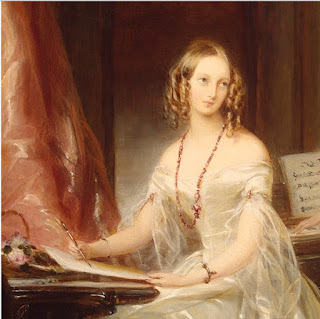
Grand Duchesses Alexandra Nikolaievna ('Adini')
and Alexandra Iosifovna ('Sanny')


Grand Duchess Alexandra Nikolaievna was the youngest daughter of Emperor Nicholas I of Russia. She died at the tender age of 19 in childbirth. 'Adini' had been suffering from tuberculosis even before her marriage to Prince Frederick William of Hesse-Kassel, but it was soon after her wedding that her health deteriorated rapidly. Her illness, her difficult pregnancy, and her tragic death was a dark episode to the otherwise happy and idyllic family life of the Russian emperor. 

Lively, talented, and mischievous, Adini was a favorite among her siblings, but she had a particular soft spot for her younger brother Konstantin who she called 'Kostya'. They bonded over shared love for music - she, a talented singer and he, a skillful player of musical instruments. Both were also artistically-inclined and voracious readers. ⁣When Adini died, Konstantin was on a sea voyage. He was then an officer of the Russian navy and when he received the news that his favorite sister died, he was profoundly affected. "...the sun's rays have faded forever in our family", he wrote in his journal. ⁣He often think about his sister, especially when he went on a campaign oversees, and he referred to her as his "guardian angel". 

3 years after the death of Adini, he fell in love with and married a German princess, Alexandra of Saxe-Altenburg. Curiously, his chosen bride not only bore the name of his dead sister, but she also looked a lot like her. 'Sanny' was a highly attractive and lively girl. Furthermore, she was also a music and an art lover. These qualities of Sanny greatly reminded him of Adini. When Sanny came to Russia and was introduced to Konstantin's mother for the first time, the Empress could not help but notice the physical resemblance and burst into tears. The sight of her future daughter-in-law undoubtedly brought back the happy and sad memories about Adini.


Grand Duke Konstantin Nikolaievich ('Kostya')
Portrait by Franz Kruger
(State Hermitage Museum, Russia)

Monday, June 1, 2020

Grand Duchess Maria Georgievna about the Grand Duchess Elizabeth Feodorovna

Grand Duchess Elizabeth Feodorovna
(Photo courtesy of https://www.worthpoint.com/)

"Grand Duchess Elizaveta Fedorovna came to [St.] Petersburg the very first winter I spent there. Her husband was the Governor-General of Moscow, and they did not often visit the capital. A few days after my arrival, the Grand Duchess called and led me to walk along the promenade. I have been especially fond of her since I first met her in Athens during my sister's engagement. She was especially kind and sweet with me, and since then we have become friends. Grand Duchess Elizabeth, Ella, was one of the most beautiful women of her time. Her head was in perfect shape, like a statue, and beautiful features. Her complexion was like rose petals, and she never used make-up or powder. At the ball, she was simply dazzling, always dressed beautifully and wore her wonderful jewelry like no other. I was devoted to her, and throughout all the years that I knew her, she was always the same kind and dear friend. The stay with her in the beautiful country house of her husband, Ilinskoe, near Moscow, was amazing. She did everything so that everyone felt at home, and could always do what she wanted. She kept herself simple, took part in all the fun and did everything in her power so that the guests had a good time."
~ From the memoirs of Grand Duchess Maria Georgievna 


Grand Duchess Maria Georgievna of Russia

Sunday, May 10, 2020

Love and Marriage Prospects of the Grand Duchess Olga Nikolaevna

Grand Duchess Olga Nikolaievna of Russia
Detail from a portrait by Christina Robertson
(State Hermitage Museum, Russia)
Beautiful, elegant, imposing and intelligent – these were just some of the words used to describe the Grand Duchess Olga Nikolaievna, the second daughter of Emperor Nicholas I of Russia and his wife Alexandra Feodorovna.

As a young grand duchess in the Russian court, she was the focus of admiration among courtiers and members of the nobility. Contemporaries described her as tall and slender, graceful, blonde, with long eyelashes and a “divine” gleam in her eyes. There was kindness and gentleness in her expression, but she was also proud and judicious.

Despite her beauty, virtues, and her status as the daughter of the Russian emperor, Olga was not lucky in love, unlike her sisters. She married a future king and became a queen, just as her parents hoped, but the relationship with her husband was far from ideal.

Olga’s older sister, Grand Duchess Maria Nikolaievna, had married a prince of low rank, Maximilian of Leuchtenberg. Consequently, the Emperor and Empress hoped that their second daughter, would make a more brilliant match. They cherished the hope to someday see Olga marry a future king, however they did not want to force her to marry someone against her will.

Saturday, March 21, 2020

"A being in close contact with the ineffable and divine..."

Grand Duchess Elizabeth in her nun's habit
Photo courtesy of Klimblim

"Although she is approaching fifty, she has kept her slim figure and her old grace. Under her loose white woolen hood, she was as elegant and attractive as in the old days before her widowhood when she still inspired profane passions… Her face in the frame of her long white woolen veil was alive with spirituality. Her delicate features and white skin, the deep, far-away look in her eyes, the low, soft tone of her voice and the luminous glow round her brow all betrayed a being in close contact with the ineffable and divine."

- From the memoirs of Maurice Paleologue about the Grand Duchess Elizabeth as a nun.

Saturday, January 4, 2020

A Mother's Advice to Her Daughter

Portrait of Princess Charlotte of Prussia as a Grand Duchess of Russia.

 Below is an excerpt from a letter of Queen Louise of Prussia to her eldest daughter, Princess Charlotte. Queen Louise never saw her daughter eventually become Empress of Russia as consort of Nicholas I as the Queen died when Charlotte was only 12 years old.

"Dear Charlotte, listen to these cheerful cries and the bells ringing with reverence... Those who want to deserve this, must respond with love to the love of their people; must have a heart capable of sharing their sufferings and joys; and the most important thing - one must be with the people... Remember this, my daughter, and if you ever get to wear a crown, remember this solemn hour."


Queen Louise of Prussia

-------------------------------------------------------------------------------------
From a letter of Queen Louise to her daughter - Princess Charlotte, future Empress Alexandra Feodorovna, wife of Nicholas I of Russia

Thursday, January 24, 2019

January 24, 1779 - Birth of the Empress Elizabeth Alexeievna


"Today, on your birthday, my dear Eliza, I write this letter in response to yours, passed by Amelia [Elizabeth's sister]. May Heaven grant you happiness and bliss in this world! This is my most heartfelt and ardent desire! But for this, you should adhere to the principle that you have defined for yourself in the form of a motto: patience and perseverance! Remind yourself that it was Providence that determined your place; leaving it voluntarily would be a sign for the disgruntled."

-Extract from a letter written by the Margravine of Baden to her daughter the Empress Elizabeth on the latter's birthday on January 24, 1811.

Saturday, September 9, 2017

The Austrian Empress and the Russian Grand Duchess


"The Grand Duchess was always terribly interested in everything that concerned the Austrian Empress. Perhaps, some envy played a part in this, since the Empress was famous for her beauty. So, for example, the Grand Duchess often asked: "Is my hair as beautiful as the Empress? Do you not find that I am like her?" I remember how she once interrogated someone who has newly returned from Vienna, where he was traveling with an order to Emperor Franz Joseph, Adjutant-General von Stühler: "Who is more beautiful, the Austrian empress or I?" General Stühler, slightly embarrassed, replied: "If the Austrian empress is the most beautiful woman on Earth, your Highness is undoubtedly the most beautiful princess! "The Grand Duchess was satisfied with this answer."

--From the "Memories of a Shipwrecked World" by Countess Kleinmichel.

Sunday, September 18, 2016

"A charming effect that is impossible to describe"


"Those who were given the good fortune to see up close the Empress Elizabeth had the opportunity to judge the extreme sociability of her nature and her extraordinary judgment. Gifted with great tact and exquisite taste, having a mass of diverse and deep knowledge, she always tried to hide her talents, as opposed to that zeal and skill with which she showed to ordinary people. Her nature had the property of contemplation which allowed her to see the serious side of her surrounding; but at the same time her passion and imagination gave her a charm and grace of simplicity; combining all these qualities engendered a charming effect that is impossible to describe."

- From an essay about the spouse of Alexander I "Empress Elizabeth Alexeievna" by Sergei Semenovich Uvarov. Published in the journal "Russian Antiquity" in 1884.

Wednesday, September 7, 2016

Tatiana Vasilievna Engelhardt, Princess Yusupova

Princess Tatiana Yusupova
by Elisabeth Louise Vigee Lebrun
Today my post is dedicated to the great-grandmother of the famous Russian belle and heiress, Princess Zinaida Yusupova
Zinaida's great-grandmother was Princess Tatiana. She was actually born as Tatiana Engelhardt into a family of an impoverished gentry in Smolenk, Russia named Vasily Engelhardt. Her mother was Martha Elena Alexandrovna Potemkin, sister of Grigory Potemkin, who would go down in history as a brilliant military leader, statesman and a lover of Catherine the Great. Tatiana's childhood coincided with that period when her uncle rose to power. As a result, she and her sisters made a brilliant match because of their uncle's influence at the Russian court. Possessing both beauty and a gentle nature, and not to mention her uncle's protection, she was destined to have a bright future.
Tatiana and her five sisters were orphaned at a very young age. They were left to the care of their grandmother and as a result, they received little education and their manners were unpolished. As their uncle Potemkin rose to power, he took the sisters under his protection and brought them to the Russian court, where the Empress Catherine treated them generously. They were treated almost as grand duchesses and soon they learned how to be sophisticated and act accordingly.

Tatiana, at the age of 12, was appointed as a maid-of-honor to the Empress Catherine. And although she came from a poor province, she attracted admiration and attention at the court not only for being the niece of Potemkin but also for being a witty and lively girl. When the Duchess of Kingston visited St. Petersburg and was invited at court, she became strongly attached to the then 15 year-old Tatiana, treating her like her own daughter. The Duchess even told Tatiana that she would make her the heiress of her vast fortune if she would agree to live with her in England. Tatiana, however, refused.
Instead, her uncle arranged her to be married to her uncle and mother's cousin who was 25 years her senior, Mikhail Potemkin. Her uncle gave her a large dowry which further made her an attractive bride. The couple had two daughters, with the Empress serving as their godmother. However, the marriage did not last long - Tatiana's husband died six years later. It was a blow for her and she retired from court life, occasionally appearing only at the request of the Empress herself. 
But soon enough, she met a dashing nobleman named Prince Nikolai Borisovich Yusupov, who had just returned to Russia from Italy where he was working at the embassy. He and Tatiana married in 1793 with Catherine's blessing and a year later, they had a son, Boris. Despite the promising start of their married life, Nikolai and Tatiana's marriage would be a failure and soon enough the couple started living separately. Nikolai stayed in Arkhangelskoye Grand Palace while Tatiana moved to Caprice Palace where she managed the Kupavinskaya textile plant, one of Prince Nikolai’s properties. Along with the management of her husband's estate, she also devoted her time in raising her son Boris.

Despite her wish for a more quiet and secluded life, this would prove to be almost impossible. Her intellectual pursuits and artistic inclinations attracted a group of likewise intellectual and artistic people who frequented her home including the Russian poet Gavrila Derzhavin who dedicated a poem for her entitled "To a mother who brings up her children herself", Vasily Zhukovsky and Alexander Pushkin.

Tatiana also proved to be skillful and highly competent in the management of their estates. Under her supervision, she was able to increase the already vast fortune of the Yusupovs (which is also due to her inheritance from Potemkin that amounted to 18 million rubles) and her practical ability and financial acumen made her acquired substantial properties. But people were surprised by her modest lifestyle and her disdain for flamboyance and ostentatious display of wealth and they sometimes mistook it for stinginess. However, she was spending large sums of money for charity which she donated anonymously.

Tatiana, with an eye for beauty, was fascinated with jewelry and she possessed some of the most dazzling jewelry collections. Among them was the world-famous Polar Star Diamond, the diamond earrings of Marie Antoinette, a sapphire statue of Venus, the pearl and diamond tiara of Caroline Murat and the Peregrina pearl.

Tatiana died in May 25, 1841 and the large fortune of the Yusupovs was inherited by her only son, Boris.

Friday, June 3, 2016

From Royal to Monastic: Grand Duchess Alexandra Petrovna of Russia

Alexandra of Oldenburg,
Grand Duchess Alexandra Petrovna of Russia
Another member of the Romanov family that I am writing about today is the Grand Duchess Alexandra Petrovna, wife of Grand Duke Nicholas Nikolaievitch, third son of Tsar Nicholas I of Russia. The Grand Duchess Alexandra was a scion of the German princely family of Oldenburg, who were descended from Tsar Paul I thru his daughter, Grand Duchess Catherine Pavlovna. The Grand Duchess Catherine married Duke George of Oldenburg and they had two sons. The youngest one, Peter, was Alexandra's father.

Prince Peter, despite his Oldenburg title, was born and raised in Russia. He married Princess Therese of Nassau-Weilburg in 1837 and together they had eight children; Alexandra was their eldest child.

Saturday, July 18, 2015

In Remembrance of the Grand Duchess Elizabeth

I had a dream last night. I dreamed about the Grand Duchess Elizabeth having a conversation with her husband. She had a sweet, gentle voice and a loving expression on her face. Her smile was very pretty and her long eyelashes flutter delicately each time. She was wearing the mourning clothes like in the picture on the right. When I woke up, it felt strange to be able to have a glimpse of what could she be like in the past. I never dreamed about her before, which was quite odd, until I realized that today was the 18th of July, the 97th anniversary of her death. Perhaps, it was like she was reminding me, with all the things that are happening currently in my life, to remember her. She fills my heart with warmth and comfort, which is what I exactly need today. No matter where life takes me, she would always be my inspiration.


Tuesday, April 21, 2015

Sisters-in-Law at the Russian Court: Elizabeth Alexeievna and Anna Feodorovna

In the last decade of the 18th century, two very young German princesses separately made a long and tiring journey from their homeland to the vast Russian empire. The first princess, Louise, came from Baden in 1793 to marry the heir to the Russian throne, Alexander. The second princess, Juliane, came to Russia in 1796 from Coburg to marry Alexander's younger brother, Constantine. Both princesses came to Russia when they were only adolescents - Louise was 13 and Juliane was 15 - and in order to become full-fledged member of the Imperial Family both were required to give up not only their names but also their religion. Upon their conversion to the Russian Orthodox Church, Louise of Baden became Elizabeth Alexeievna and Juliane of Coburg became Anna Feodorovna.

For the first three years of her married life, Elizabeth had no closed female friend at Court to whom she could share her intimate thoughts and feelings. She had no one to turn to for a 'girl talk' since she was not even particularly closed to Alexander's sisters. But everything changed with Anna's arrival in Russia. Here was a new girl who also came from Germany and who was also subjected to the same bride-choosing ordeal as Elizabeth was when she came to Russia with her sister three years ago. They had so much to share with each other - news from Germany, the latest fashion trend, the music and the dances, the balls...and they could converse to each other in German. Elizabeth was more than happy to welcome the newcomer and soon she was writing an enthusiastic letter to her mother about her new sister-in-law:
"Julia is such a wonderful child: kind, polite, trustworthy, and she is the best friend I could ever dream of. She is cheerful and amusing... She has brown hair, brown dazzling eyes, and a pretty mouth..."
As for Anna, she likewise immediately felt comfortable with Elizabeth. Only two days after her arrival, she suddenly approached Elizabeth during a ball, held her hands, and called her in a German endearment equivalent to "darling". This vivacity initially surprised Elizabeth but she felt quite amused of Anna's naivete and spontaneity.
Grand Duchesses Elizabeth Alexeievna and Anna Feodorovna as young wives
Elizabeth and Anna were actually poles apart. In terms of physical appearance, Elizabeth was blonde while Anna was a brunette. Temperamentally, Anna was more vivacious and exuberant, while Elizabeth was the serene and soft-spoken one. But they have a thing in common: the two grand duchesses were highly acknowledged for their pretty faces and charming manners. Prince Eugen of Wurttemberg wrote about the two grand duchesses when he met them in St. Petersburg:
…During these early days of my life in St. Petersburg, I was introduced to Grand Duchesses Elizabeth and Anna, the wives of Alexander and Konstantin. The first, a former Princess of Baden, was lovely and kind, and at the same time possessed the most gentle character. The latter was probably even more a striking beauty, but still she could not overshadow the charms of Elizabeth…”
The then ruler of the Russian Empire was the indomitable Empress Catherine the Great. She was the one, through her careful machinations, who was largely responsible for these two early marriages of her grandsons. She was nonetheless delighted of her granddaughters-in-law and asked Mme. Elisabeth Vigee Le Brun to do a portrait of them.


Mme. Le Brun described Elizabeth to be 'ravishing' and a 'heavenly figure'
while she described Anna to be 'sweetly pretty' and with features of 'life and mirth'.

After her death, the throne was inherited by her despotic son who became Paul I. Paul resented his mother and upon his accession he was swift to enact changes and undo some of her mother's legacy. The brilliance and opulence of Catherine's reign was quickly replaced by military-structured and austere Court life which proved to be exceedingly stifling and boring for his two older sons and their wives. Court life was never the same as before. In this highly oppressive environment, coupled by Paul's temperamental and volatile nature and his wife Maria Feodorovna's obvious dislike of her daughters-in-law who treated them a little more than ladies-in-waiting, it was not surprising that the two young wives, Elizabeth and Anna, drew closer to each other. Elizabeth wrote to her mother several weeks after Catherine's death:
" I am certain, dear Mother, that the death of the good Empress affected you deeply. As for me, I can assure you that I cannot cease thinking of it. You have no idea how every little thing has been turned upside down. All this made such a wretched impression on me, especially in the first days, that I scarcely recognized myself. Oh, how awful those first days were! Anna was my only consolation, as I was hers. She practically lived with me, coming here in the morning, dressing here, having dinner on most occasions and remaining all day until we would go together in attendance on the Emperor. Our husbands were hardly ever at home and we could find little to do with ourselves, the way of life not having been regulated in every aspect."
In these early years of their life in Russia, Elizabeth was happily married to Alexander. They were a good-looking couple and their marriage was clearly based on friendship and mutual respect, if not love. But the same cannot be said of Anna and Constantine. Their married life was becoming increasingly unhappy as the months went by. From the beginning, Constantine was indifferent from his wife, and made no efforts to gain, at least, her friendship. He was moody and bad-tempered, totally dedicated to his military career, and Anna was too outspoken not to berate him about it and his lack of affection. This almost always resulted in quarrels between husband and wife. Despite his disinterest in his wife, Constantine proved to be an extremely jealous and insecure boy who exercised a very tight control over his wife. He was jealous of his brother Alexander's close friendship with her and he resented her increasingly popularity at Court. Whenever Anna earned admiring glances and remarks, he would forbade her to leave her rooms. In her misery, the usually cheerful and witty Anna soon became sickly and dispirited. She relied heavily on Elizabeth for moral and emotional support, as she was the one who could relieve the tension and smooth things out between the frequently quarreling couple. Throughout the duration of Paul's reign, Anna led a miserable married life.

After the death of Tsar Paul in 1801, Anna decided once and for all that her marriage is over. She left Russia and once in Coburg refused to return to Russia. She was determined not to go back to her unhappy life and immediately she started divorce proceedings against her husband. It was a bold move in her part despite her family's initial lack of support. It certainly says something about her character. She never returned to Russia but she and Elizabeth continued writing to each other well until Elizabeth's death in 1826. In the absence of Anna, Elizabeth once again felt lonely and deprived of a closed female friend within the imperial family. The new Empress certainly missed Anna, who settled permanently in Switzerland, that when she had a new sister-in-law, Charlotte of Wurttemberg later Elena Pavlovna, she confided to her mother how Elena reminded her so much of Anna and how her tender feelings for the new grand duchess were reminiscent to that she had for Anna more than twenty years ago.

Despite the subsequent breakdown of her marriage and the many other tribulations in her life, Elizabeth was determined not to follow Anna's example and leave Russia. She was fully resolved to stick to her husband and her marriage, knowing that he would one day finally come to his senses and return to her.

The close friendship between Elizabeth and Anna was the result of those early years they spent in Russia when they first knew opulence under Catherine the Great and which eventually gave way to a time of uncertainty and stifling formality under Paul I. In those uncertain times, they found comfort and solace with each other, and these helped them get through to their early life in the intimidating grandeur and magnificence of the Russian court.


Elizabeth and Anna in later life. Elizabeth would die at 47 and Anna at 79.


Monday, April 6, 2015

The Daughters of Prince Ivan Baryatinsky

Prince Ivan Baryatinsky was one of the most influential nobles in Russia of the early 19th century. He was a wealthy landowner and the owner of several palaces throughout Russia and Europe. As the sole heir of his father, Prince Ivan inherited the vast fortune of his family. He first served in the Yekaterinoslav Hussars of the Russian Imperial Army as a young man, and he later distinguished himself as an astute diplomat and was made Russian ambassador first in London and then at the court of the King of Bavaria in Munich. While he was on a diplomatic service in London, he met and married an Englishwoman named Frances Mary Dutton, the daughter of Lord Sherborne. They had one daughter, Elizabeth, but Frances Mary died in 1807. Later that year, Prince Ivan was sent to Bavaria as the Russian ambassador and there he met and married a German countess, Maria Keller, with whom he had four sons and three daughters. It was a match made in heaven. Prince Ivan and the now Maria Feodorovna were a good-looking and generous couple, and enjoyed a successful marriage. Prince Ivan was especially interested in agronomics and applied the things he learned from his travels all over Europe in the development and management of his estates. Princess Maria Feodorovna, on the other hand, was a philanthropist. She was particularly involved in charity and other social causes. After their marriage, Prince Ivan built a magnificent palace complex in Kursk which he named "Marino" in honor of his first and second wives. In here, his children grew up and received an excellent education with special emphasis on Christian values. Thus, the Baryatinsky children will grow up to closely follow their parents' examples in philanthropy and social astuteness.


Princess Olga Ivanovna Baryatinsky,
Countess Orlova-Davydova 
Olga, born in 1814, was the eldest daughter of Prince Ivan and Maria Feodorovna Keller. She married Count Vladimir Petrovich Orlov-Davydov in 1832. Count Davydov was a scion of one of the most powerful noble families in Russia. He was a wealthy landowner and a philanthropist. He was educated in Britain and as a result, he acquired a great love for Britain and its culture. Olga and Davydov primarily lived in Orel and there Olga took interest in the welfare of the people. She was described to have possessed a wonderful character. Her simplicity and unassuming ways particularly in the way she treats peasants amazed courtiers and dignitaries. Like her mother, Olga had a developed social conscience. She and Davydov made it a point that charity must be a foremost importance in their life. They built schools, churches, hospitals and charitable institutions. The writer Aksarov who had the opportunity to see the couple's charitable work was surprised with their attitude towards ordinary people. He wrote that they "lead a living union with the Church, and not less than a living union with the Russian people", and that the "Russian village became a part of Olga's moral being". She was well-acquainted with peasant life and with the needs of the people both in general and in detailed. After her mother's death, Olga inherited the guardianship of the Community of the Sisters of Charity, which her mother founded. 


Princess Leonilla Ivanovna Baryatinsky, 
Princess of Sayn-Wittgenstein-Sayn
Born in 1816, Leonilla was the second daughter. The princess, like her brothers and sisters, was highly educated and cultured. When she was 16 years old, her mother brought her to St. Petersburg to be introduced to the Empress Alexandra Feodorovna. She immediately became famous at the court for her attractive looks. She was described to be tall like a 'Lebanese cedar, slender, somewhat restrained and very serious, but beautiful from head to toe'. Her 'velvet eyes and sable eyebrows' gave her an 'Italian look'. In the spring of 1834, she became a maid-of-honor to the Empress. However, less than year after her appointment, the beautiful and cultured Leonilla married the Tsar's aide-de-camp, Prince Ludwig of Sayn-Wittgenstein-Berleburg, who was also a widower. After their marriage, Leonilla and her husband left Russia and settled in their estate in Vilna, Lithuania. Prince Wittgenstein inherited a vast fortune from his first wife, which afforded him and Leonilla to lead a luxurious lifestyle. Following her mother's example, Leonilla was also interested in charity and founded several schools and hospitals for the poor. Although their marriage started happily, Leonilla and her husband soon drifted away from each other. She converted to Catholicism and fell into a sort of religious mania. She had an affair with a Frenchman while her husband settled in the wing of the castle with his German mistress. Before the the Prince's death in 1866, he and Leonilla were somewhat reconciled. "Thus ended", wrote the writer Smirnov, "this married life that started with feigned love, passed on for a short time in indifference, and then in friendship..." As a widower, she became a close friend of the Empress Augusta of Germany and tried to help her resolve a number of diplomatic issues to prevent the Franco-Prussian War. In the last 30 years of her life, Princess Leonilla lived in a villa at Ouchy, overlooking Lake Geneva. For many years, her homes has been a "bourne of crowned heads and imperial personages". One of her oldest friends is the Dowager Grand Duchess of Mecklenburg-Strelitz, 94, who, until the outbreak of the war, would visit once a year. Until the last days of her long life, Leonilla, kept an excellent memory and a sober mind. She died in 1918 at the age of 102.


Princess Maria Ivanovna Baryatisnky,
Princess Kochubey
The youngest daughter of the family, Maria, was born in 1818 . Like her mother and her sisters, she was also a famous beauty at the Russian court. She also became a maid-of-honor to the Empress Alexandra and a close friend of the Empress's daughter, Grand Duchess Olga Nikolaievna. The Grand Duchess fondly remembers Maria in her memoirs:
"After the start of the Lent was the end of all celebrations. Only a few were invited to gather in the evening with Mama in the Green Room, where for the most part we read aloud. Among these guests were Princess Baryatinsky and her daughter Maria. Her shyness and modesty endeared her to me and soon we became friends. She was serious and deeply religious. The friendship between us was truly what I've always dreamed of: she ennobled our nature. We both were full of ideals according to our age... We are especially protective of our desires, thoughts and ideas from prying eyes. Maria Baryatinsky was blond with black eyebrows, her eyes if she sympathized with anyone, were full of warmth, which I have not seen in anybody, except for the Empress Maria Alexandrovna (wife of Emperor Alexander II), perhaps because I truly loved them both.
Maria Baryatinsky's hair was the same as mine. When she unravels her hair, it covered her knees. She plaits it into a twine three times around the head and fastened it with gold pin. I remember one birthday celebration of Papa in Peterhof. Despite the fact that Baryatinsky lived nine miles from there, she came with fresh flowers on her hair. Most of the flowers were still in bud, and during a dance, they were dispersed. The portrait by the famous artist Robertson captured her in all her charms while she was about to play the piano. In 1841, she married Mikhail Kochubey, and eighteen months later she is gone. She died of a fever... How short this friendship was! But this remains an indelible trace in my soul. Her sister Leonilla, the future Princess Wittgenstein. was also very attractive, but her beauty was of the earth, while Maria was like an angel. In Maria, I found an echo of myself, and this four-year friendship was just beautiful. "
After Maria's early death, her mother founded a shelter for poor women as a dedication to her.


Portraits of Prince Ivan Baryatinsky and Princess Maria Feodorovna nee Keller

Monday, January 26, 2015

Royal Portrait: The Grand Duchess Alexandra Feodorovna of Russia

The future Empress Alexandra Feodorovna of Russia, consort
of Nicholas I, portrayed here when she was still a grand duchess.
By Henri Benner, 1821 (From the Hermitage Museum)
"On St. Peter's day the imperial family met at the chateau. It was there that I saw the Grand Duchess Nicholas for the first time, and I was struck by the elegance of her form and the beauty of her tall figure. Surrounded by her ladies in waiting, whom she surpassed by a head, you would have said it was Calypso in the midst of her nymphs."
 --From the memoirs of Madame la Comtesse de Choiseul-Gouffier

Tuesday, December 9, 2014

The Romance of an Empress


The Romanov Family was infamous for its story of drama and tragedy. It was this aspect that probably fascinates people the most. Each member of the family, whether they were born into it or married into it, seems to have his or her own unique story to tell. And so for today, I'd like to explore one of the least known member, Empress Elizabeth Alexeievna, wife of Alexander I.

Emperor Alexander I's life was a mystery and continues to be so. His upbringing, his role in his father's death, his domestic and foreign policies, his personality, and the circumstances of his death are all shrouded in enigma. His wife Elizabeth and her life also has its own fair share of drama, tragedy, romance, and mystery. When I was reading about Elizabeth's life, it was like watching a soap-opera and a legend rolled into one. I could not help but be fascinated with this lady, although largely unknown to most history buff, was still quite a personality. She was adored by poets and musicians, and contemporaries and later historians and authors are drawn to her; and it's quite understandable why. Elizabeth was an attractive woman. Her beauty was often described as the angelic kind and this gave her an almost unearthly and ethereal appearance. She was both beautiful and intelligent but sad and inaccessible. She was the perfect muse for an uninspired artist, the perfect heroine of a doomed love story, and the perfect angel to a lost man.


Friday, October 3, 2014

The Grand Duchess and Her Palace


The Grand Duchess Maria Nikolaievna, eldest daughter of Emperor Nicholas I of Russia, was a gifted artist. Her artistic and aesthetic inclinations led her to do numerous paintings in watercolor and she delightfully engaged in interior decoration; she decorated her own rooms and when she received a palace of her own, the Mariinsky Palace in St. Petersburg, as a wedding present, she transformed it into one of the most imposing in the city. As a lover of the arts, Grand Duchess Maria built a beautiful collection of paintings from Russia and from different parts of  Europe. A lady-in-waiting recalled the time when she went to the Mariinsky palace for the first time and she was struck by the splendid interiors and the grand duchess's taste for beauty and the arts.

"... I went to the Grand Duchess Maria Nikolaievna... I found her in her luxurious winter garden, surrounded by exotic plants, fountains, waterfalls and birds; a mirage of spring in a January frost. The palace of Grand Duchess Maria Nikolaeivna was truly a magical castle, thanks to the generosity of the Emperor Nicholas to his beloved daughter, and the taste of the grand duchess, who managed to subdue the wealth and luxury which she was surrounded, shows the diversity of her artistic imagination. She was generously endowed by nature, which is coupled by a striking beauty of her subtle mind, friendly nature and excellent heart, but she lacked the lofty ideals of spiritual and intellectual interests... "

-From the recollection of Anna Feodorovna Tyutchev, 
lady-in-waiting at the Russian court

Friday, August 29, 2014

The Daughters of Emperor Paul I of Russia

The daughters of Emperor Paul I: (From left to right:)
Alexandra, Elena, Maria, Catherine and Anna 

Emperor Paul I of Russia and his second wife, Empress Maria Feodorovna, née Princess Sophia Dorothea of Württemberg, had six daughters: Alexandra, Elena, Maria, Catherine, Olga, and Anna. All of the grand duchesses, with the exemption of Olga who died when she was only two years old, married into the royal houses of Europe. Shy and gentle Alexandra married the Archduke Joseph of Austria and lived in Hungary; sensitive and altruistic Elena became a Princess of Mecklenburg-Schwerin when she married Friedrich-Ludwig, Hereditary Prince of Mecklenburg-Schwerin; intelligent and artistic Maria married Grand Duke Karl Friedrich of Saxe-Weimar-Eisenach and presided over the cultural development of Weimar; vivacious and strong-willed Catherine was first married to Prince George of Oldenburg and after his death she married the future King William I of Württemberg; and the youngest and sombre Anna became a Dutch queen when she married King William II of the Netherlands.

Emperor Paul, beyond his purported eccentricities and cruelty, was a doting and devoted father to his children, while the Empress Maria was a woman of strong character who was determined to maintain unity and order within her large family. The grand duchesses thus grew up in an idyllic atmosphere of happy family life. They were educated to a high standard, and were taught the necessary skills for their future roles as consorts. Duty has always comes first before one's self. But behind the glittering palace rooms and dazzling court life where these grand duchesses spent their childhood, their lives would never be easy. As they faced a future of uncertainty, it was but their only desire to be of good use to their adoptive countries that made them strive, above all else, to be dedicated consorts and overcome their ever-present longing for their beloved Russia.


Monday, June 2, 2014

A Rare Vision

Portrait of Grand Duchess Alexandra Nikolaievna of Russia (1825-1844) From the Hermitage Museum
"Her lineaments seemed suddenly to recall forcibly her mother and also her grandmother, Queen Louisa [of Prussia]. Among the retinue of the Empress were still persons who retained a lively recollection of Queen Louise, and who were struck by the likeness. [She] showed indescribable grace in all her movements, especially in dancing, so that her parents liked to look at her; even in her mode of walking in the street, where she appeared in all her simplicity and quite unknown, she struck every passer-by as a rare vision. From her features beamed even more than the wonted courtesy of a princess, or the easy cheerfulness of a girl; beyond all others, she was distinguished by elevation of thought, and goodness. Her slightest smile lighted up her whole face, her glance was full of intellect and heart, and on her lofty brow was written true dignity. Many beauties cause astonishment, but permit the spectator no nearer approach; the youthful Alexandra delighted by her first few words, for they came from the warmest depths of her heart. Neither pride nor cold reserve, but intellectual life and spirit, animated her whole being."
- Theodore Grimm, Alexandra Feodorowna, Empress of Russia 

Wednesday, May 28, 2014

The Queen and the Empress

Queen Louise of Prussia and Empress Elizabeth Alexeievna of Russia

In 1809, Tsar Alexander I and the Empress Elizabeth welcomed King Frederick William III of Prussia and Queen Louise in St. Petersburg. The lovely and vivacious Prussian queen managed to charm the whole court, even the Empress Elizabeth herself. The sight of these two beautiful women together caused quite a sensation at the Russian court. Apparently, Louise and Elizabeth instantly "clicked" and they were to become very good friends. Observers were quick to notice the physical resemblance between the two and Joseph de Maistre, Sardinian ambassador to Russia wrote in his memoirs:
"[Queen Louise] has often been compared to the reigning Empress [Elizabeth]. The Queen may be a beautiful woman, but the Empress is a more beautiful sovereign."
After the Prussian couple's departure, Queen Louise and Empress Elizabeth continued writing to each other. Louise wrote to Elizabeth about her and her husband's return to Berlin:
"Our entry was a very touching experience. The people received us with the utmost joy. We could feel that they welcomed us with all their hearts. The King has never been more popular. We see only friendly faces everywhere. God be thanked that we are again in Berlin. Whatever we may still have to endure will be more easily endured here."
Elizabeth was very fond of the Prussian queen. She confided to her mother her thoughts about Louise:
"There is no need for me to measure my words and exercise prudence in speaking of the Queen of Prussia. It is impossible for anyone to be more delightful, more easy to get on with than she is. I cannot think how those reports about her affectation and coquetry originated. I have never seen a trace of any such thing. She was extremely sociable, and one could note the liveliness of her natural disposition. Her relations with the King were quite a pleasure to me. In society she was sure of her position and quite at her ease. Alone with me she was genuinely friendly and confidential. If there is any shade in her portrait I assure you it is barely perceptible."

Thursday, March 27, 2014

"The True Goddess Was Revealed With Her Step..."

Portrait of the then Grand Duchess Elizabeth Alexeievna of
Russia, c.1800. From The Royal Collection.

This was how the Comte de La Garde de Chambonas described the Empress Elizabeth Alexeievna of Russia during her stay in the Austrian capital for the Congress of Vienna in 1814. He described her as an "angel on earth", and went on to say that:
"She was endowed with a charming face, her eyes reflecting the purity of her soul. She had magnificent auburn hair, which, as a rule, was allowed to fall loose on her shoulders. Her figure was elegant, lithe, and supple, and even when she wore mask, her walk revealed her identity in a moment. No woman realised more thoroughly the line of Virgil: 'Incessu patuit Dea...' To a most delightful disposition there were added a cultivated and quick intellect, a passionate love of art, and a boundless liberality in money matters. The graceful elegance of her person, her noble bearing, and her inexhaustible kindness won her all hearts. Neglected almost from the first hour of her union by a husband whom she worshiped, her solitude and grief had bred a kind of melancholy. Stamped on every feature, that feeling lent to the accents of her voice and to her slightest movements an irresistible charm."


From:
Anecdotal Recollections  of the Congress of Vienna
by the Comte de La Garde de Chambonas


Related Posts Plugin for WordPress, Blogger...
 
Powered by Blogger